Bed and Breakfast hotels in Burgundy
Are you planning to stay in Burgundy and looking for a hotel? Campanile offers you comfortable rooms and tasty treats at the best price!
Services CAMPANILE
-
Accès wifi
-
List of hotels
Sort by: brand distance PriceStarting from EUR 45
Hotel 3 stars - 61 km from downtown
The Dijon hotel benefits from a privileged location. Booking your 3-star hotel with Campanile puts you 5 km from the historic town (...) See hotel description
Starting from EUR 45
Hotel 3 stars - 2 km from downtown
This hotel in Dijon is in an ideal location. Make a reservation with Campanile for this hotel and you will be 6 km from Dijon Long (...) See hotel description
Starting from EUR 45
Hotel 3 stars - 2 km from downtown
WELCOME TO HOTEL CAMPANILE AUXERRE MONÉTEAU Situated 1 km from exit 19 Auxerre-Nord on the A6, our hotel /restaurant Campanil (...) See hotel description
Starting from EUR 45
Hotel 3 stars - 1 km from downtown
The Campanile Hotel Mâcon is ideally located between Beaujolais and Burgundy, making it an ideal base for exploring the region and (...) See hotel description
Starting from EUR 49
Hotel 3 stars - 94 km from downtown
Situated at the heart of the Bouchardes shopping district, the south Mâcon - Chaintré Campanile Hotel-Restaurant occupies a privil (...) See hotel description
Starting from EUR 49
Hotel 3 stars - 5 km from downtown
Avallon is known for its beautiful old town with cobbled streets, Romanesque architecture and traditional stone and woodwork build (...) See hotel description
Starting from EUR 49
Hotel 3 stars - 57 km from downtown
The Campanile Hotel & Restaurant Dijon - Gare boasts 83 rooms and is located just 100 metres from the SNCF railway station, 50 (...) See hotel description
Starting from EUR 51
Hotel 2 stars - 1 km from downtown
There is no better place to stay than the Hotel Restaurant Campanile Nevers Nord- Varennes Vauzelles if you wish to explore the ci (...) See hotel description
Starting from EUR 55
Hotel 3 stars - 2 km from downtown
Close to the wine trails and vineyards of the Côte Chalonnaise (Givry, Mercurey and Montagny), 1.5km from exit 25 on the A6 motorw (...) See hotel description
Starting from EUR 55
Hotel 3 stars - 60 km from downtown
WELCOME TO HOTEL CAMPANILE DIJON-NORD TOISON-D’ORVery easily accessible from the A31, A38 and A39, this 3-star Campanile hotel is (...) See hotel description
-
-
Useful information
-
To discover
-
The city
-
Description
Bourgogne or Burgundy, located in central France, is considered the "heart" of the country. The name of the region comes from the Burgundians, an ancient Germanic people who settled in the area during the early Middle Ages. Originally, the region was dominated by the Romans, forming part of Gallia Lugdunensis (Celtic Gaul). When the Germanic tribe came and established the first Kingdom of Bourgogne in the 5th century, the region became a rich asset that incited several conquerors to action. At one time, there were four Burgundies, parts of which extended to modern-day Switzerland! Indeed, in the Middle Ages, Burgundy was the great dukedom that rivalled in power and prestige the kingdom of France itself.
Today, the Burgundy region is composed of 4 French departments. Northern Burgundy is home to Yonne (89), capital Auxerre , a rolling agricultural area bordering on the outer fringes of the Paris region. To the west, Nièvre (58), capital Nevers , is a hilly department that includes the highest peak of the Morvan hills and a large part of the Morvan regional nature park. The Côte-d'Or department (21), around Dijon , is both hilly and flat while Saône & Loire (71) in the south of the region showcases flat valleys.
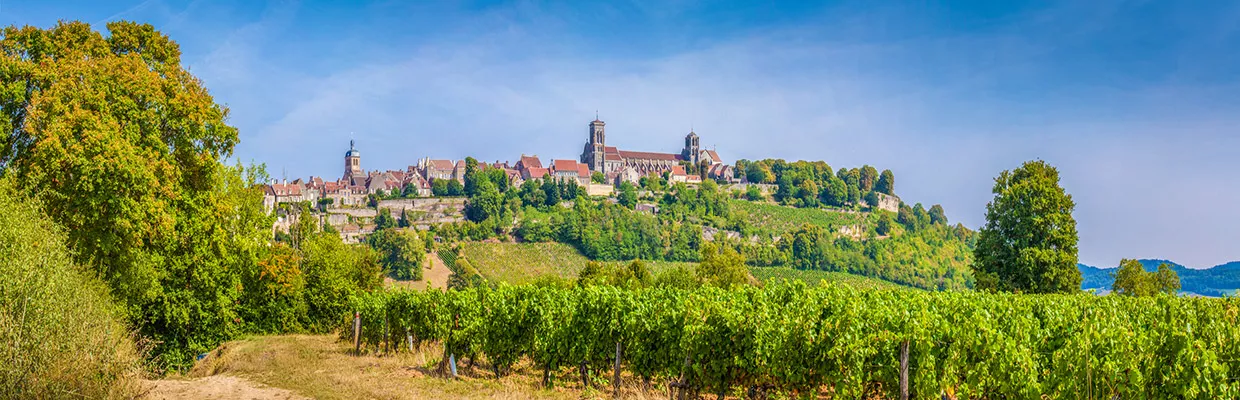
Each department boasts rich culinary delight, historic monuments and beautiful landscapes. Not just a wine region, Burgundy highlights include the Hospices de Beaune with its dazzling tiled roof, l'Abbaye de Fontenay and the Romanesque basilica at Vézelay. The monastery of Cluny is breathtaking, not to mention castles such as Cormatin and Ancy-le-Franc. Picturesque medieval villages with timber-framed houses, cobbled streets and fortified gateways dot the region, along with superb museums like the Museum of Beaux-Arts, which contains the finest collection of paintings and sculptures outside of Paris. For nature lovers, take a canoe on one of the lovely lakes in the Morvan forest, or simply glide down the canals in a leisurely boat.
Explore the varied cities of Burgundy when staying with Campanile hotels! -
To discover
Cities
Dijon, the historical capital of the Burgundy region, boasts an unusually large number of churches and cathedrals, as well as superb museums such as the Musee Magnin and Musee des Beaux-Arts de Dijon. Famous for its mustard, this university town is lively and majestic. Visit Autun, the Roman heart of Burgundy and a town rich in history and architecture, surrounded by the beautiful countryside. For sports fans, Auxerre is not to be missed, which is famous for its football team, as well as its timber-framed houses. And Beaune , the centre of the wine region, steeped in wine culture, is surrounded by sprawling vineyards. Wine connoisseurs will head straight to Chablis , the town known as the golden gate of Burgundy for its great wine, while foodies will venture to Joigny, home of one of France's best known restaurants, La Cote St-Jacques. History buffs will not forget Vezelay, a designated UNESCO World Heritage site with a historical basilica at the heart of the medieval town. Other notable cities include St Florentin , Semur-en-Auxois , Chatillon-sur-Seine and Saulieu .
Gastronomy
Burgundy is one of France's main wine producing areas. It is well known for both its red and white wines, mostly made from Pinot Noir and Chardonnay grapes, respectively, although other grape varieties can be found, including Gamay, Aligote, Pinot Blanc, and Sauvignon Blanc. The region is divided into the Côte-d'Or, where the most expensive and prized Burgundies are found, and Beaujolais, Chablis, the Côte Chalonnaise and Mâcon. The reputation and quality of the top wines, together with the fact that they are often produced in small quantities, has led to high demand and high prices, with some Burgundies ranking among the most expensive wines in the world. Not surprisingly, famous Burgundian dishes include wine, notably coq au vin and beef bourguignon. Other mouth-watering specialties include poulet de bresse (Bresse chicken), escargot a l'ail (garlic snails with parsley) and poussin a la moutarde (hen with Dijon mustard).
Transport
Burgundy is easily accessible by all transports. For English tourists, crossing the channel is relatively cheap and fast. By train, visitors can visit the region via the TGV and TER, which run regularly from Paris or Lyon to Dijon. From nearby cities, motorways allow visitors to thoroughly explore the nooks and crannies of Burgundy. In addition, buses regularly cross the four departments. For cyclists, traveling the region via bicycle is quite simple.
Interesting fact
During the middle ages the Dukes of Burgundy became so rich and so powerful that they rivaled the King of France who was both a blood relative and theoretically their feudal overlord. They maintained their more or less independant status by switching alliances between the King of France and the King of England (who also claimed the throne of France). Their actions helped prolong the battles between the French and English kings into what is known as the Hundred Years War. -
Useful Information
Transport
Burgundy is easily accessible by all modes of transport. For English tourists, crossing the channel is relatively cheap and fast. By train, visitors can visit the region via the TGV and TER, which run regularly from Paris or Lyon to Dijon. From nearby cities, motorways allow visitors to thoroughly explore the nooks and crannies of Burgundy. In addition, buses regularly cross the four departments. For cyclists, traveling the region on a bicycle is quite simple. Gastronomy: Burgundy is one of France's main wine-producing areas. It is well known for both its red and white wines, mostly made from Pinot Noir and Chardonnay grapes respectively, though other grape varieties can be found, including Gamay, Aligote, Pinot Blanc, and Sauvignon Blanc. The region is divided into the Côte-d'Or, where the most expensive and prized Burgundies are found, and Beaujolais, Chablis , the Côte Chalonnaise and Mâcon . The reputation and quality of the top wines, together with the fact that they are often produced in small quantities, has led to high demand and high prices, with some Burgundies ranking among the most expensive wines in the world. Not surprisingly, famous Burgundian dishes include wine, coq au vin and beef bourguignon. Other mouth-watering specialities include poulet de bresse (Bresse chicken), escargot à l'ail (garlic snails) and poussin à la moutarde (hen with Dijon mustard).Events
Burgundy offers festivals for popular and eclectic tastes alike. The Musicaves in Givry is an eclectic music festival bringing together classical music with world music, jazz and wine tasting laid on by the local winegrowers of Givry in the Côte Chalonnaise. The magnificent natural site at Alise-Sainte-Reine sees pop, rock, world and folk during the Nuits Peplum d’Alésia. Les Zaccros d’ma rue in Nevers is a big festival celebrating street art in all its forms.Interesting fact
During the middle ages the Dukes of Burgundy became so rich and so powerful that they rivaled the King of France, who was both a blood relative and, theoretically, their feudal overlord. They maintained their more or less independant status by switching alliances between the King of France and the King of England (who also claimed the throne of France). Their actions helped prolong the battles between the French and English kings into what is known as the Hundred Years War.Useful links
http://www.burgundy-tourism.com<
http://www.region-bourgogne.fr/
http://www.burgundytoday.com -
Back to top